
Use this guide to assess your current content plan or compare an SEO proposal. Start with stakeholder questions, turn recurring sales objections into page briefs, check the paths to commercial pages, and agree on measurement with sales before commissioning more content.
Map buying decisions before choosing keywords
Start with the offers you can deliver profitably and the accounts you can serve. Search volume is not evidence of purchase intent. A glossary term may attract students, consumers, or job seekers. Check its query mix and landing-page performance against sales-accepted inquiries before expanding the topic. Keep educational content when it supports a relevant buying decision, not simply because it ranks.
Map the committee for each priority offer. The technical evaluator checks compatibility, specifications, and limitations. The operations lead checks implementation effort, downtime, and support. Finance or procurement checks total cost, contractual terms, and supplier risk. These are not necessarily consecutive funnel stages: different people can enter through different pages, revisit the same evidence, and veto a purchase for different reasons.
Collect their actual wording from discovery calls, sales engineering notes, RFPs, and lost-deal reviews. Add relevant Search Console queries where available. A low-volume estimate should trigger validation, not automatic rejection; an unsupported assumption should not become a content cluster. A useful content strategy maps each evidenced question to a page, a proof requirement, and an appropriate commercial next step.
Turn sales engineering and RFP questions into page briefs
Review recurring pre-sale questions with sales engineers, implementation staff, and procurement contacts. Extract the underlying decision from each request for proposal (RFP), rather than copying its wording wholesale. Remove customer names and confidential architecture details. Record who asks, what could block approval, what evidence resolves it, and which internal expert can verify the answer before publication.
Build each brief around an offer and a decision. Specify the intended reader, supported use case, prerequisites, limitations, evidence, and next step. A technical page might need supported versions, API constraints, or an integration diagram; a procurement page might need deployment options, contractual responsibilities, and a dated explanation of relevant certifications. Distinguish documented capability from planned functionality and custom development.
Prioritize questions that recur in real opportunities, expose a purchase blocker, and match work you want to win. Consider expected account value and production effort, but do not mistake an elaborate scoring sheet for demand evidence. Use a technical review or scoped consultation as the next step when a generic contact form lacks context. Combine questions that serve the same decision instead of manufacturing thin pages.
Connect useful guides to credible capability pages
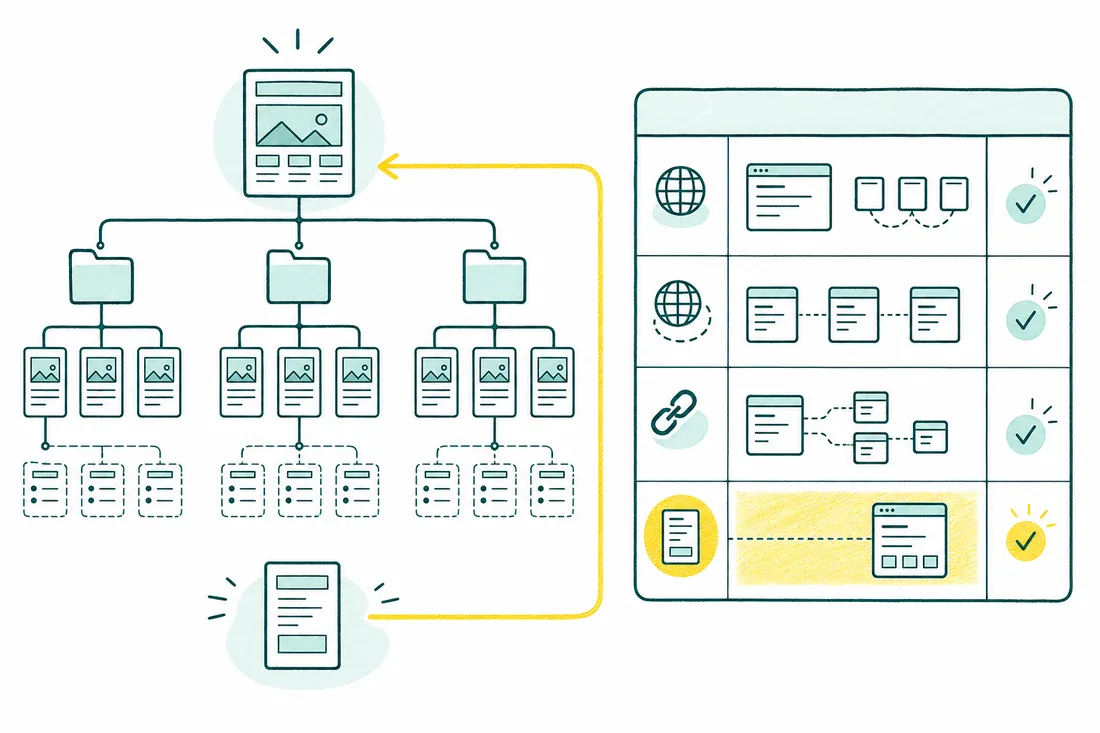
A guide explains the decision; a capability page shows whether your company can deliver. That destination may be a product, solution, integration, or service page. It needs a clear fit statement, delivery boundaries, supporting evidence, and an inquiry path. Sending every reader to a generic homepage forces the buying committee to reconstruct the offer for itself.
Place contextual links where the next evaluation question arises. A migration guide can point to implementation support; an integration checklist can point to the relevant supported integration. Use anchors that describe the destination rather than repeated “learn more” links. Apply the structure in the service-page copywriting guide to make scope, prerequisites, proof, and next steps easy to evaluate without a sales call.
Use Google’s people-first content guidance as a quality check: does the intended audience leave with enough useful detail to move forward? Publish dated specifications, meaningful diagrams, and reviewed explanations where appropriate. For comparisons, state the use case and evidence behind each distinction. Keep sensitive security documents behind a suitable access process while making public eligibility criteria and the review process clear.
Check URL roles, search signals, and delivery ownership
Compare /guides/b2b-seo-strategy/ with /services/content-strategy/ as a guide-to-service pattern: the guide explains decisions; the service defines delivery and fit. Test that each returns HTTP 200, is indexable, and declares its intended canonical URL. Use URL Inspection to compare the declared and Google-selected canonical where available. Distinct, useful pages should not accidentally point to one shared canonical destination.
Compare each question cluster’s intended destination with the pages actually receiving impressions in Search Console. Several URLs appearing for related queries do not automatically mean cannibalization. Review titles, H1s, evidence, internal anchors, and next steps before merging anything. Google’s SEO Starter Guide provides the fundamentals for clear page organization and crawlable links; test important links in rendered HTML rather than relying only on visual navigation.
Assign the editor to positioning, source accuracy, and page differentiation. Assign engineering or the relevant specialist to capability claims, the developer to templates and technical fixes, and SEO to query mapping and validation. Use a content audit to distinguish updates, consolidation, and genuine page gaps. Every recommendation should name an owner, an acceptance check, and a dependency—not merely label a page “optimize.”
Measure qualified pipeline and buy a defined scope
Define a qualified inquiry with sales: target company type, relevant need, delivery fit, and an agreed next step. Track form submissions, booked consultations, and useful document requests separately. With consent where required, pass source and landing-page context into the CRM; keep names, email addresses, and confidential project details out of analytics. A download is not automatically a sales opportunity.
Report sales-accepted inquiries, opportunities, stage movement, and opportunity value by offer and acquisition cohort. Separate pipeline created from revenue won, and label first-touch versus assisted attribution. Review cohorts against the actual sales cycle. Search Console can separate branded and nonbranded query trends, but it cannot identify which search query created a particular CRM opportunity. Do not present that connection as established fact.
When comparing providers, request a buyer-question map, prioritized page backlog, expert review process, implementation owners, and CRM reporting definitions. A B2B SEO content package should specify updates versus new pages and review responsibilities. If tracking is missing, fund that setup first; if credible commercial pages already exist, improve their evidence and paths before commissioning another publishing calendar.
Pre-implementation verification checklist
- Confirm priority offers, target account characteristics, and the criteria sales uses to accept an inquiry.
- Validate each priority question against sales conversations, RFPs, customer evidence, or relevant search data—not volume estimates alone.
- Assign a destination page, subject-matter reviewer, implementation owner, and appropriate next step to each question cluster.
- Test indexability, internal links, inquiry tracking, and CRM source fields before publishing or promoting the pages.
Frequently asked questions
Can B2B SEO work when keyword tools show no volume?
Yes, if sales evidence supports the topic. A low or zero estimate can reflect sparse tool data, not absent buying demand. Validate the question in sales calls, RFPs, support discussions, and Search Console where available. Start with a focused capability page or section, then assess qualified inquiries before expanding production.
Should we delete glossary pages that attract lots of traffic?
No. First check the queries they attract, the commercial pages they support, and whether sales uses them during evaluation. Improve pages that answer relevant buyer questions. Consolidating overlapping articles or removing unrelated material are separate decisions; low direct conversion alone is not a sound reason to delete an entire glossary.
What should a B2B SEO engagement deliver?
Expect a target-account definition, stakeholder question map, query-to-page plan, prioritized briefs, expert review process, and measurement requirements. The proposal should distinguish updates from new pages and assign implementation responsibilities. Ask how sales feedback changes priorities after launch. An article quota without commercial destinations and qualification criteria is not a complete strategy.
How long before B2B SEO produces qualified pipeline?
Set milestones around your starting point and actual sales cycle rather than accepting a universal deadline. First verify discovery, relevant search visibility, and qualified inquiries. Then follow acquisition cohorts through opportunity stages. Technical fixes and content publication are delivery milestones; closed revenue depends on buyer timing, sales follow-up, and the fit of the offer.