
A brand mention, a source link and a customer inquiry are three different outcomes. Keep them separate when deciding whether this work is helping.
Choose a question a real customer would ask
Start with the decision, not your brand name. For an illustrative local repair business, a useful question might ask for a provider that handles a particular repair in a real service area. Another might compare repair with replacement. Those questions require different evidence and may produce different answers.
Record the exact wording, country or location, language, date and whether ChatGPT used search. Save the answer and its actual links. A Google AI Overview for the same question is a separate observation, not a substitute for a ChatGPT test.
Repeat a small set of questions under comparable conditions. One answer is useful for investigating a source; it is not a reliable market-share measure.
Check search access without confusing it with AI training
Review whether public pages are reachable, contain their important text in readable HTML and link to the right services. If there is a crawler block, identify what is blocked before changing it.
OpenAI distinguishes OAI-SearchBot, used for search, from GPTBot, used for training-related crawling. Its crawler documentation also describes ChatGPT-User. Allowing a training crawler is not the price of entry to search, and allowing a search crawler does not guarantee inclusion.
Check both the site’s robots rules and any relevant security/CDN restrictions. Do not disable general security protections simply to make a bot-access test pass.
Make the business easy to understand and check
A buyer should be able to establish what you do, whom you serve, the real location or service area, relevant limitations and how to contact you. Keep important details consistent across your website and legitimate public profiles.
Write service pages that answer buying questions: suitable jobs, what is included, what affects the price, proof you can actually show and the information needed for a quote. A generic “trusted, innovative, customer-focused” introduction gives a reader little to evaluate.
Relevant professional profiles, industry publications and customer reviews can provide more context. Keep business details consistent and make ownership clear when you publish on a site you control.
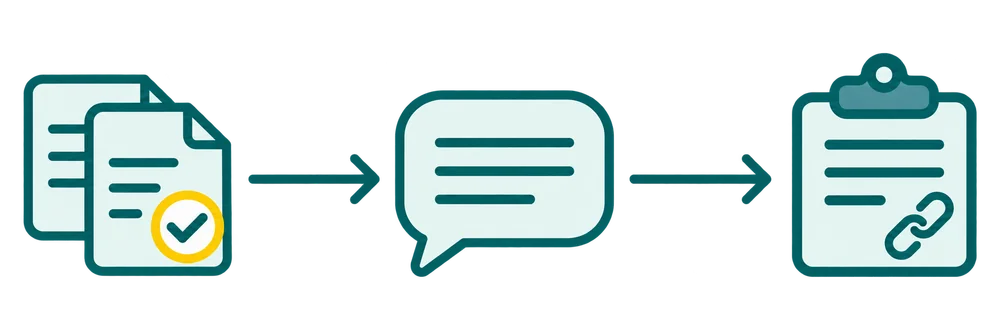
Check the evidence behind an answer and record observed source links with the exact buyer question, platform, and date.
Read the sources behind the recommendation
When an answer cites a competitor, open the linked page. Does it answer the question directly? Is it a business page, a comparison or a third-party directory? Which claim does the link actually support? A citation is not a quality certificate for every sentence on that page.
Then identify what your own page lacks. Perhaps customers cannot tell whether you cover their area, the comparison omits an important limitation, or the quoted price has no scope. Improve the useful information rather than copying the competitor’s wording.
Turn the gap into a specific page experiment: a clearer service-area statement, a comparison with stated criteria, an original example or a better explanation of the cost. Keep ChatGPT observations separate from Google’s AI search features, because the platforms may use different sources.
Track mentions, source links and inquiries
For each successful observation, note whether your business was named, whether your own page was cited and whether another cited page described you. Keep failed tests and answers without search separate. Follow any identifiable referral visits through to genuine inquiries where your analytics and consent setup allow it.
Use the AI visibility measurement guide to organize the records. For question research, source analysis and page improvements, see my AI search research and optimization scope.