Included scope
Research and plan
$495USD · English · one-off
- 10 questions × 2 search platforms × 3 dates: 60 attempted checks
- Up to 3 cited source pages and 5 of your pages reviewed
- Observation sheet and improvement plan; no page edits
SEO services
I check how Google AI and ChatGPT answer questions about your products or services, which sources they use and what your website is missing. We use those findings to choose pages to improve.
Start with your website and the products or services you want people to understand. No introductory call is required.
An example of the deliverable
A blank format for dated AI-search observations.
| Query / market | Platform / date | Observed answer and sources | Page opportunity |
|---|---|---|---|
| Agreed question 01 · target country/language | Google AI Overview · first check | Not yet checked. Record the answer and exact cited URLs, or no Overview / unavailable. | Complete only after reviewing the answer and cited pages. |
| Same question and market | ChatGPT Search · first check | Not yet checked. Record the search context, answer and linked sources, or unavailable. | Separate what was observed from a recommendation. |
Repeat across three dates over seven days: 10 questions × 2 platforms × 3 dates = 60 attempted checks. Unavailable answers are recorded separately.
The counts define the work included. They are not a reason to add unnecessary pages or changes.
Included scope
$495USD · English · one-off
Included scope
$895USD · English · one-off
01
Search visibility depends in part on whether relevant pages can be found and understood. For Google’s AI features, Google says established SEO practices remain relevant. I review work already underway so technical fixes and content improvements can stay in one plan.
AI search adds other questions to investigate: How is the business described? Does the answer link to your site or to someone else? Are details accurate? What makes a cited page useful to a potential customer?
You may see this work described as generative engine optimization (GEO) or answer engine optimization (AEO). Providers use those terms with overlapping scopes. My SEO, GEO, and AEO guide explains the terminology; a proposal from me specifies the actual work rather than treating each label as a separate package.
02
I start with the questions people ask while choosing an offer like yours. The sample includes discovery and comparison questions as well as appropriate branded checks. We agree on the platforms, markets and repeat dates before collecting observations.
The research becomes a practical source-and-page review:
| Finding in the sampled answers | Work I would assess |
|---|---|
| Your business is mentioned with outdated service information | Check the underlying sources and prepare the correction |
| Competitors are cited for a useful buying comparison | Review the missing information and evidence your page can add |
| Your own page is cited but the answer misses a key condition | Make that condition clear and check its supporting information |
| No useful result appears for the tested question | Revisit the question, available sources and whether a relevant page exists |
You receive dated answer observations, source URLs and the proposed page changes. The record explains whether the change belongs on your website or needs action from another publisher.
You can inspect my 14-query Google AI Overview study to see a dated source review. It is a same-day country-level sample, useful as an example of the method.
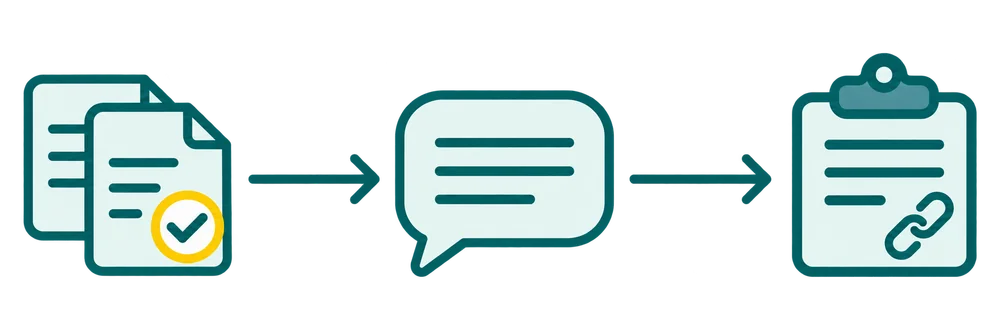
Check the evidence behind an answer and record observed source links with the exact buyer question, platform, and date.
03
An illustrative example: a small service business might ask which scheduling software suits a three-person team and works with its existing accounting system.
A product page saying “built for every business” gives little help with that decision. More useful information could explain supported integrations, setup requirements, relevant limitations, and the type of customer the product is designed for. I would verify those details with the business before adding them.
I can rewrite an existing page, prepare a new page for a genuinely different need, or create a brief for your writer. The work uses your verified product details, relevant examples and sources to make the buying decision clearer.
I use AI-assisted research and drafting where useful, then review the sources, wording, and final recommendations myself.
04
I investigate access restrictions, indexing issues, and other technical problems affecting the pages we want to make discoverable. Suitable WordPress changes can be included; custom development requires an agreed handoff to your developer. My technical SEO service covers that investigation and implementation support.
The controls differ by platform. OpenAI documents OAI-SearchBot for search and GPTBot for model training, with independent preferences. I do not treat permission to appear in search as permission to use content for training.
For Google, I also review the relevant Search generative AI control in Search Console. This is a Google Search setting, not a universal control for ChatGPT, the Gemini app, and other assistants. Changes are discussed before implementation, including any restrictions you intentionally want to keep.
05
I define the measurement before the work starts, so you know which results the report can show.
| Signal | What the report tells you |
|---|---|
| Brand mention | Whether the sampled answer names and accurately describes the business |
| Source link | Which page is cited and what it supports in the answer |
| Google AI impressions | Available Search Console data for AI Overviews and AI Mode |
| Referral visit | Visits analytics can identify from the relevant source |
| Inquiry or sale | Correctly measured business outcomes associated with those visits |
Question observations include the platform, mode, language, market context and date. Repeated checks use comparable conditions; their coverage is the defined sample.
Where available, Google’s Generative AI performance report provides site-link impressions in AI Overviews and AI Mode. Those impressions overlap with Web performance and should not be added to the Web total. I confirm property access and data availability before including that report.
Analytics helps with identifiable visits and outcomes; it cannot count every answer that mentions you. The AI visibility measurement guide provides practical tracking fields and examples. Paid tracking tools are considered when the question set and frequency justify them.
06
I have more than 10 years of SEO experience and continue to develop Zovovo and Supplement Explained, my own publishing projects. That work brings search research, editorial decisions, internal linking and technical implementation into the same workflow.
A focused review can lead to page improvements or ongoing observation. The proposal names the platforms, outputs, implementation responsibilities and fee.
I can research the answers, improve the information you publish and track the agreed questions. The platform decides which businesses and sources it includes. Google explains that its AI features use established SEO foundations without a special markup requirement.
An example from my work
Supplement Explained · Google AI report · 11 June–10 September 2026
These formats are adapted to the agreed scope; they are not published client documents.
07
Send your website, the offer you want to make clearer, and any platform you are particularly concerned about. An example question or an inaccurate answer you have seen can help define the work. Please remove private customer information before sharing it.
Illustrative deliverable excerpt
Citation checks record the platform, prompt, market, date, and exact cited URLs. Search Console and crawl data establish Google discovery and page accessibility, while direct page checks verify source content; the citation evidence comes from the recorded AI responses. Each finding receives an owner and a repeatable review step.

| Observed signal / URL pattern | Root cause | Action & owner | Verification check |
|---|---|---|---|
| Recorded comparison answers cite other sources; the relevant service page is indexed but contains only broad claims. | Page review finds no usable comparison criteria, limitations, or supporting sources for the buyer’s question. | SEO: prioritize commercially relevant comparison prompts. Editor and service owner: add a factual comparison section with clear criteria, fit limits, and primary-source support. | Repeat matched prompts in fresh sessions with platform, retrieval mode, market, and date recorded. Log exact cited URLs and whether the answer accurately represents the page, separately from brand mentions. |
| The public URL returns HTTP 200, but essential specifications appear only after a browser interaction and are absent from the initial HTML. | The source material depends on client-side fetching; a simple page retrieval receives the shell rather than the answer content. | Developer: publish essential specifications and answers in the initial HTML of the canonical page, keeping interactive controls as enhancements. SEO: review access rules for the intended search crawlers. | Compare initial HTML with the rendered page. Check robots rules, HTTP headers, and cookie-free access for the intended crawler; confirm the essential facts are available without interaction. |
| An AI answer cites a first-party PDF but repeats retired service coverage that differs from the current service page. | The older PDF remains public with outdated facts, and no content owner maintains consistency across source formats. | Service owner and editor: verify current coverage and update the page and downloadable document. Developer: redirect a retired document only when a genuine replacement exists. | Inspect the exact cited URL and current document contents. Repeat the prompt and record answer accuracy and citation destination separately, retaining persistent outdated citations in the follow-up log. |
Build a baseline with AI search visibility measurement, define the evidence with AI visibility audit deliverables, and check source quality with the AI-generated content audit guide.
Practical guides
Understand the problem, compare your options and choose the right support.
Evaluate the scope, evidence and useful next steps before paying for an AI visibility review.
Read the guideAn original, same-day review of 14 US and Turkish Google searches: cited sources, useful content patterns and claims worth checking.
Read the guideSeparate brand mentions, source links, website visits and leads. Build a practical AI visibility baseline with Search Console, GA4 and repeatable checks.
Read the guide