SEO services
White-label SEO services for agencies
I take on research, content updates, technical checks and agreed website changes for your agency’s clients. You keep control of client communication and approvals; I keep you updated in writing.
What will you receive?
- The agreed research, content or technical work.
- Clear handover notes for your team.
A short description, target date, and the kind of support you need are enough to start. You do not need to arrange an introductory call.
01
White-label SEO audits, content and implementation
You can hand over a defined part of the SEO workload while keeping your account management and existing team in place. I carry out the research, writing or agreed implementation myself.
| Assignment | What your team receives |
|---|---|
| Keyword and competitor research | A dated search review, page mapping and reasons for the recommendations |
| Content brief or page refresh | A brief for your writer or edited page copy with metadata and links |
| Technical investigation | Evidence, affected URLs, prioritized actions and a verification method |
| WordPress implementation | The agreed changes, a release check and a concise handoff |
| Editorial or release review | Issues to resolve, completed checks and items needing client confirmation |
My content support can fit around your writers. A technical review can cover a defined problem, template or site section. We agree on the boundaries and delivery format before I estimate the work.
02
Agree on the assignment before the work starts
I review the goal, available data, access, and deadline before estimating effort. You get a written scope and fee, with an indication of the time required and the assumptions behind it. Those assumptions might include receiving approved product details or getting access to a staging site.
An existing brief and working document can be enough. I adapt to your agreed handoff format and reporting routine; a new dashboard is not a condition of working together. We identify one person who can answer questions, resolve conflicting instructions, and approve the work.
If research reveals something larger than the original assignment, I flag it and explain the options. Additional work is agreed before I take it on. Missing access or client information is identified as a dependency, not covered up with a confident guess.
03
You keep the client relationship
Sales, account management, and client meetings can stay with your agency. My communication is primarily written: questions, decisions, progress, and items that need your approval. I prepare notes your team can use without requiring you to relay every detail from a live meeting.
We agree on how the work is branded and who sees the drafts. Direct client contact and permission to publish are separate decisions. I do not contact the client or change the live website unless that is part of the agreed assignment.
Access is limited to what the work requires. I also agree on confidentiality and tool-use requirements before handling client material. Unpublished work and private data are not turned into portfolio examples without permission. Any AI-assisted research or drafting must fit your agency’s and client’s data rules; the output still receives source and editorial review.
04
What a focused handoff could look like
An illustrative assignment: your team has a service page that needs a refresh before the client’s next review. You provide its URL, the business goal, available search data, brand guidance, and approved service information.
I research the page and competing results, identify unanswered buying questions, and prepare either a brief or finished copy. The handoff includes the agreed title, description, links, and page changes, along with any facts still awaiting client confirmation.
Your agency reviews the work. Implementation can remain with your team or become an agreed part of my assignment. If publication QA is included, I check the actual page after release and report what was changed and what remains open.
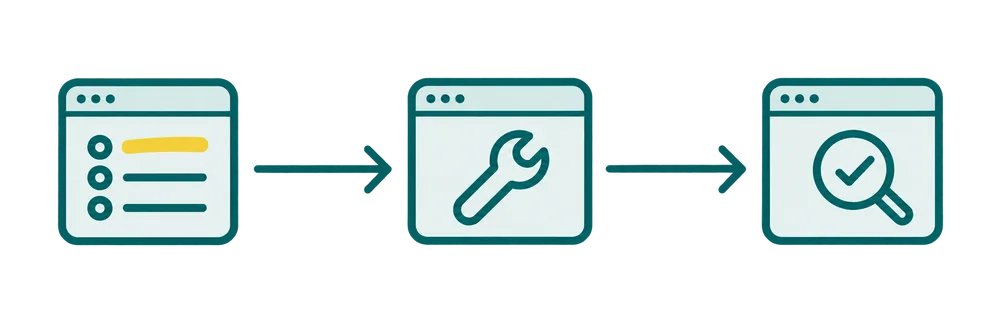
Record what matters, who will do the agreed work, and how completion will be verified on the live URL.
05
Completion should be easy to verify
Your team should be able to open the handoff and see what needs attention. I use your task system or working document, with the status, owner and next action beside each item.
Illustrative review note: a page refresh is ready for editorial approval, one product claim is awaiting client confirmation, and implementation belongs to your developer. Those are three visible items with different owners. Once published, the release check records the page URL, date and any remaining correction.
For content, I check the brief, approved facts, page purpose and links. For a technical assignment, I check the behavior specified in the task. Performance follow-up uses the agreed pages and period.
The outsourcing SEO quality guide explains the review points. The SEO audit deliverables guide shows the fields that turn findings into work your team can assign.
06
Experience working inside agency projects
I have more than 10 years of SEO experience, including agency work at GroupM Istanbul. Across my agency career, I worked on more than 100 client websites in total. That work included projects for Kliksa, Teknosa, and BMW through previous agency roles.
Today I work independently from Tallinn, Estonia. You deal with me on the research, recommendations, and agreed changes, with written communication that your team can refer back to.
Can we start with one assignment?
Yes. We can agree on a paid, focused task such as a page review, content revision, or technical investigation. That gives both sides a practical way to assess the working fit before discussing recurring support.
Can you provide ongoing capacity?
Ongoing support is planned around the work you need and the time I can commit. We agree on priorities and target dates, then revisit capacity when the workload changes. Additional requests are reviewed against the agreed scope and the time available.
An example from my work
SEO work inside an agency team
Past agency experience · GroupM and Brands&Clicks · role summary, not client documents
- Experience
- SEO work across more than 100 client websites during my agency career, spanning research, technical and on-page priorities, and implementation coordination.
- Communication
- At GroupM, I coordinated projects with international teams by email. Written updates and shared documents are still my strongest working format.
- For your agency
- Your team retains the client relationship. I prepare the agreed research, edits or recommendations and make the handover clear.
- Evidence boundary
- Past client analytics and internal agency documents are not published here. The linked background and public award record describe the relevant experience.
What can the deliverables look like?
These formats are adapted to the agreed scope; they are not published client documents.
- Assignment summary
- The client goal, affected pages, access needed, estimated time and who approves the work.
- Team-ready handover
- Findings, recommended changes and supporting URLs in your agency's agreed format.
- Quality check and update
- What was completed, what was verified and what still depends on your team or client.
07
Tell me what your team needs to hand over
Send the type of work, the client’s objective, the target date, and whether you need recommendations, finished copy, implementation, or review. A redacted brief is helpful if you already have one. I will follow up by email to clarify the assignment and estimate the work.
Illustrative deliverable excerpt
A client-ready summary and a developer-ready handoff
I separate the client decision from the implementation detail, then attach evidence that another reviewer can check. Your account team gets a clear explanation; developers get URL examples, expected behavior, and acceptance criteria.

| Observed signal / URL pattern | Root cause | Action & owner | Verification check |
|---|---|---|---|
| The executive report says 'fix indexation'; the linked ticket says 'update canonicals' without affected URLs, expected targets, or release criteria. | One generic finding was reused for both the client decision and the developer handoff. | SEO reviewer writes a client summary covering impact, priority, and dependencies. Ticket owner adds affected URL patterns, expected signals, implementation notes, and acceptance criteria. | Account lead confirms the requested decision is clear. Developer and QA reviewer can identify the affected URLs, intended behavior, and pass conditions without reconstructing the audit. |
A ticket is closed after staging QA, but production /services/repair/ still declares /services/ as canonical; GSC's indexed snapshot predates the release. | Release acceptance checked staging only and treated an older indexed snapshot as evidence of the current deployment. | Developer checks the production template. SEO reviewer compares HTTP status, raw HTML, rendered canonical, and GSC indexed versus live results, attaching dated evidence to the ticket. | Confirm production returns 200 with one intended self-referencing canonical. Record the live-test result, then revisit Google's selected canonical in indexed inspection after recrawl. |
| An AI visibility report counts a brand mention as an owned-site citation, although the linked source opens a third-party directory. | Brand mentions and linked sources share one reporting field, with no recorded final destination URL. | Analyst records the prompt, platform, date, market, language, captured answer, and resolved source URL. Reviewer separates brand mentions, owned-site citations, and third-party citations. | Match each claimed citation to the captured answer and final URL after redirects. Record later retests as new observations so different responses are not merged into one evidence entry. |
Use the white-label SEO audit guide to define the client-facing deliverables and the outsourced SEO quality-control guide to assign review and acceptance responsibilities. When AI search is included, the AI visibility audit deliverables guide explains what the citation evidence should contain.
Practical guides
Related SEO guides
Understand the problem, compare your options and choose the right support.
White-label SEO audits: What should an agency receive?
Know what to ask a specialist for before putting your agency name on an SEO audit.
Read the guideHow to outsource SEO work without losing quality
Hand off SEO work with clear scope, inputs, approvals and checks. Use a practical content-refresh brief to manage implementation, extra work and client updates.
Read the guideWhat should an SEO audit include?
Learn what makes an SEO audit useful: specific findings, clear priorities, implementation responsibilities and checks that show whether a fix was completed.
Read the guide